Campaign Setup
Part of Programmatic campaign optimisation
Balancing prospecting and retargeting budgets
Review prospecting and retargeting spend using audience opportunity, mature outcomes and the value of additional delivery.
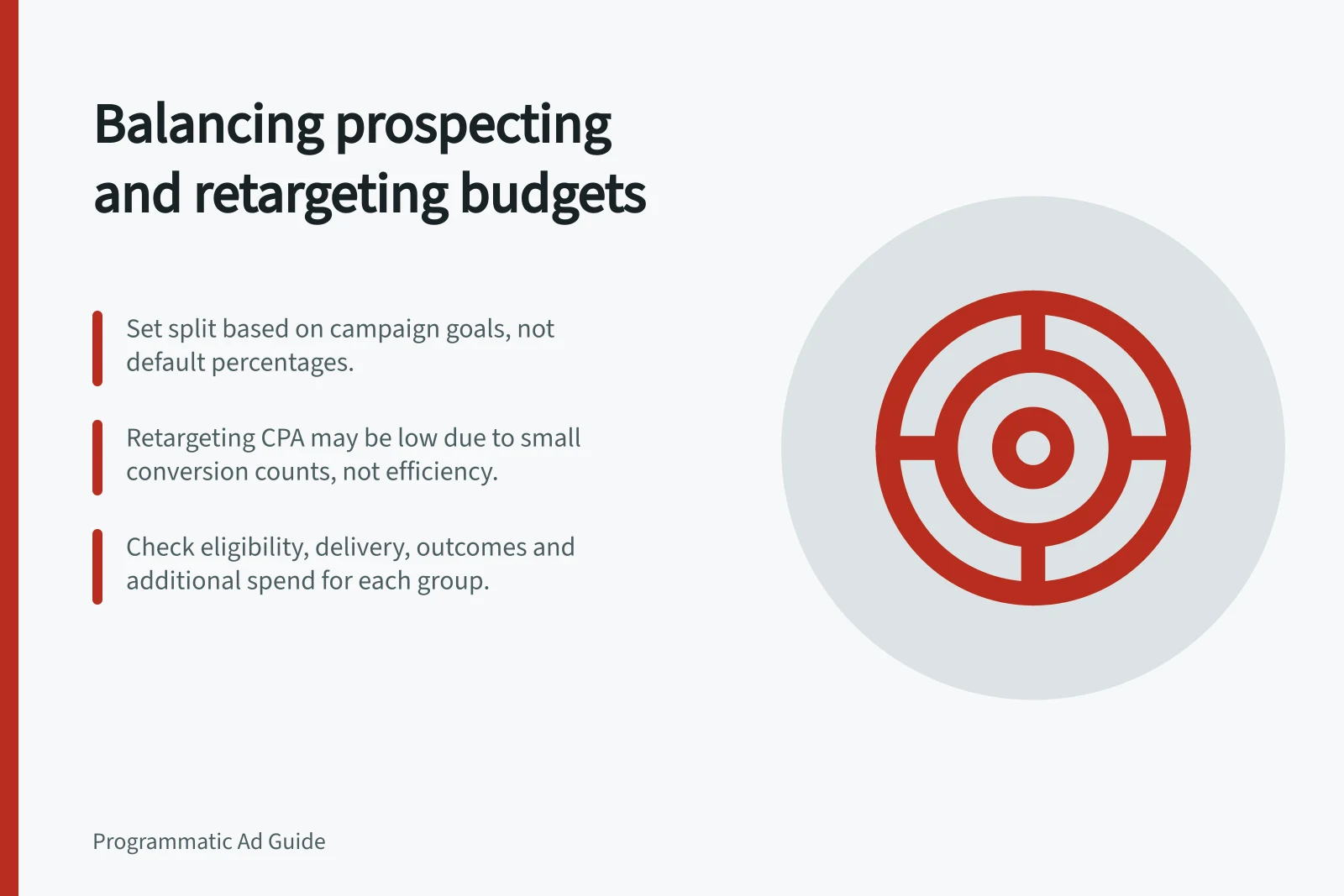
Set the prospecting and retargeting split by judging what additional spend in each group is likely to achieve under the campaign goal. No dependable default percentage exists.
Retargeting can show a lower reported cost per attributed action because it selects people who interacted earlier. That report does not show how many extra actions the ads caused.
Give each budget a job
Define prospecting as the campaign's eligible audience beyond its specified retargeting rule. Define retargeting by the prior action that makes a person eligible.
Record inclusion and exclusion rules, message, primary outcome, available inventory and authorised spend for each. The groups may have different paths to action, so their reported rates need context.
Check whether the retargeting list is current and whether its membership rule still describes people who need the message.
Treat reach and inventory estimates as planning signals, not a precise count of people available for this split.
Prospecting vs Retargeting: Key Differences in Performance and Strategy
- Audience DefinitionProspecting: New users outside retargeting rules. Retargeting: Users who previously interacted with the brand.
- Cost Per Attributed ActionRetargeting typically shows lower CPA due to higher conversion likelihood; however, this does not reflect incremental lift from additional spend.
- Inventory AvailabilityProspecting may face limited relevant inventory early on; retargeting pools can shrink over time.
- Reporting ConsiderationsReach estimates are planning signals, not exact counts. Delivery and frequency data are more reliable for decision-making.
Look for the next useful opportunity
Read mature outcome counts and cost beside delivery and reach where reliable. Retargeting may encounter a small pool or repeated exposure; prospecting may need more time before an action.
A low retargeting CPA from a few attributed conversions is weak grounds for taking most of the prospecting budget. Equally, an allocation to prospecting needs review if it cannot find relevant inventory.
For each group, ask:
- Eligibility:What relevant opportunities remain under its rules and flight?
- Delivery:Is it spending, and where are requests filtered or lost?
- Outcome:How many completed actions are sufficiently mature under the agreed definition?
- Additional spend:Is more budget likely to buy useful new exposure or mostly repeat existing delivery?
These are judgement questions, not a formula. When reach reporting is unavailable or uncertain, use the delivery and frequency evidence that exists and label the gap. Inspect creative, inventory and the landing page before treating a weak prospecting result as a budget problem.
Evaluating Budget Allocation: A Four-Step Review Process
- EligibilityAssess whether relevant audience opportunities remain under current rules and campaign flight.
- DeliveryCheck if spending is occurring and identify where ad requests are being filtered or lost.
- OutcomeReview mature action counts under agreed definitions (e.g., conversions, sign-ups) to assess performance.
- Additional SpendDetermine if more budget will drive new exposure or just repeat existing delivery.
Key Metrics to Monitor for Budget Decisions
- Delivery RatePercentage of ad requests that result in impressions or clicks
- FrequencyAverage number of times a user sees the ad; high frequency may indicate over-exposure
- Reach EstimatePlanned audience size based on targeting criteria; use as guidance, not precision
Keep the allocation intentional
Document a working split, an authorised adjustment range and a review date. Protect any minimum required by the brief or a defined learning period.
Move a limited amount when the receiving group's next opportunities look more useful, then check whether its outcome quality holds as delivery expands. If one role cannot deliver usefully under the brief, revise the allocation decision rather than preserving a percentage for its own sake.
Check automation before calling the split fixed; confirm how it may affect budgets and whether it is suitable for a split that must stay within set amounts.
Inspect the automation settings and saved budgets that actually govern the two groups; separate insertion orders or platforms require separate checks.
Report the roles separately and explain the trade-off. If evidence is sparse, retain a bounded allocation and state what further delivery or mature outcomes would justify a change.
Pros and Cons of Adjusting Prospect and Retargeting Budgets
- Pros of Increasing Retargeting BudgetHigher conversion likelihood, lower CPA, faster results; ideal for driving immediate actions.
- Cons of Increasing Retargeting BudgetLimited audience pool, risk of ad fatigue, diminishing returns as list shrinks.
- Pros of Increasing Prospecting BudgetExpands reach, builds awareness, supports long-term growth; essential during learning phase.
- Cons of Increasing Prospecting BudgetMay struggle to find relevant inventory early; higher CPA until audience learns and optimises.