Bidding & Pacing
Part of Programmatic campaign optimisation
Diagnosing performance changes before raising bids
Check reporting, eligibility, auction losses and outcome quality before deciding whether a higher programmatic bid is justified.
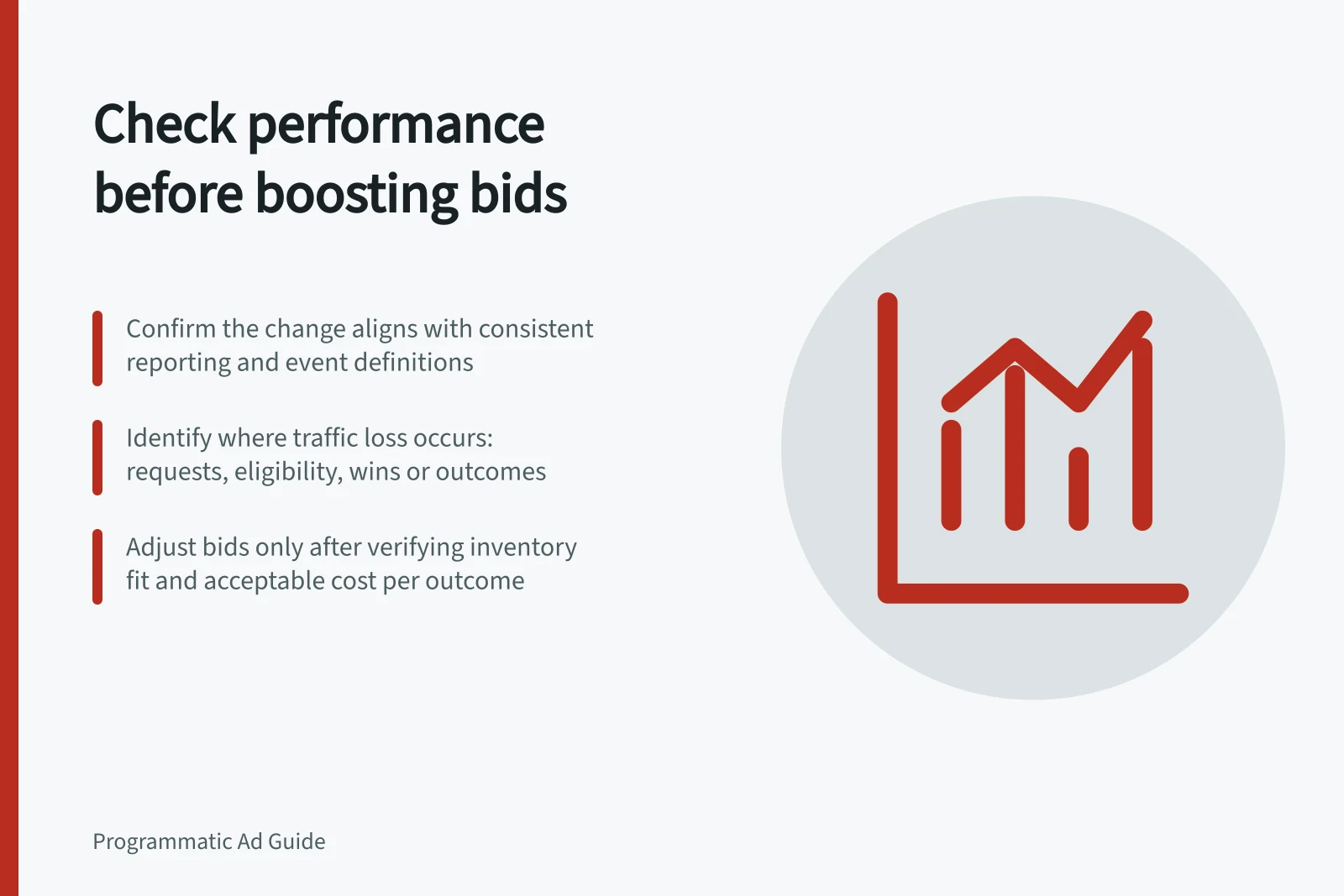
When campaign performance changes, check reporting, delivery and the bought traffic before raising bids. A higher bid may help when valuable eligible impressions are being lost on price. It cannot repair a broken event, unsuitable placement mix or creative that cannot serve.
Confirm a comparable change
Name the measure that moved: completed enquiries, purchases, qualified visits or another agreed outcome. Compare periods using the same cost basis, event definition, attribution settings and reporting cut-off. Label recent conversion figures as provisional, and do not infer how long this campaign's customers take to act from a short reporting window.
Inspect the counts beneath a rate. A few outcomes can produce a large swing. Check whether a tag, landing page, offer, creative or report setting changed near the break before treating it as an auction problem.
Key Reporting Considerations
- Metric to Track
- Completed enquiries, purchases, qualified visits or agreed outcome
- Cost Basis
- Consistent across comparison periods
- Attribution Settings
- Must match across periods
- Reporting Cut-off
- Use same cut-off point for all comparisons
- Conversion Status
- Label recent figures as provisional
Find which stage moved
Compare requests from the selected inventory source, filtering, bid responses, wins, spend and the primary outcome where those figures are available. Display & Video 360 provides troubleshooting for deals and line items that can help show where volume is being lost. Where detail is unavailable, treat it as unknown, not zero.
| Pattern | Check next | Why a higher bid may be premature |
|---|---|---|
| Fewer requests from the selected source | Dates, inventory source, market and format | Price cannot create requests that did not reach that view. |
| Requests arrive but fewer remain eligible | Targeting, creative, frequency and budget controls | The bidder may not enter those auctions. |
| Eligible bids increasingly lose on price | Floor, reported loss reasons and placement value | A bid change may help only at an acceptable cost. |
| Wins and spend hold steady while outcomes fall | Placement mix, creative, page and event health | More of the same traffic may weaken efficiency. |
These patterns direct investigation; they are not diagnoses by themselves. Several changes can coincide.
Make the bid decision
If price appears to be the constraint, check whether the lost inventory fits the brief and whether its likely cost is acceptable for the next useful outcome. Keep any change within authorised limits. Record the expected effect on wins, cost and outcome.
For an automated Display & Video 360 strategy, inspect its target KPI and any maximum-average-CPM setting. Relaxing a target changes the efficiency trade-off, and these settings should be reviewed before bids are altered.
If the constraint is eligibility, address the specific discretionary rule or creative issue while retaining required limits.
If delivery is healthy but outcomes worsen, investigate the bought inventory, page and event before adding spend. Save a dated baseline, then review bids, wins, cost and sufficiently mature outcomes together. Reverse or revise a bid increase that adds cost without enough useful result.