Campaign Setup
Part of Programmatic audience targeting
Setting exclusions before a campaign launches
Define excluded audiences, check list IDs and recency, and verify the saved rules before a programmatic campaign starts.
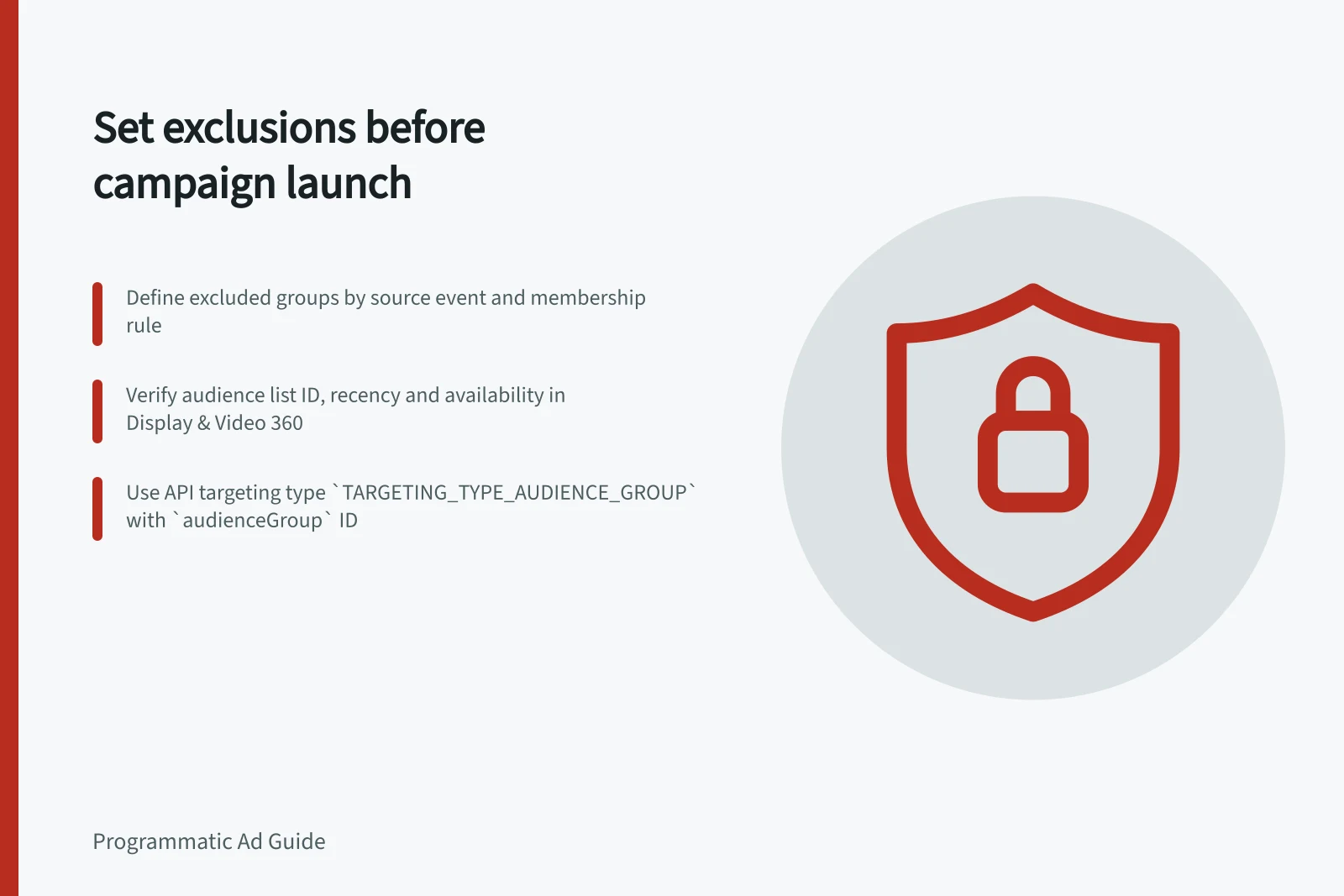
Before activation, define who must be ineligible, identify the audience list for each group, and verify the saved exclusion on every affected line item. Check each list's membership rule, recency, availability and name. Audience exclusions concern people or device signals; placement and content exclusions address different risks.
Display & Video 360 provides audience-list targeting at line-item level. Its API identifies the audience targeting option set with the ID value audienceGroup.
Audience Exclusion Types in Display & Video 360
- Audience Exclusions
- Target people or device signals (e.g., exclude recent purchasers)
- Placement Exclusions
- Block specific websites, apps, or placements (e.g., avoid competitor sites)
- Content Exclusions
- Avoid content categories (e.g., exclude news, adult content)
Define each excluded group
“Exclude existing customers” is incomplete. Decide whether it covers anyone who purchased, recent purchasers or current subscribers. Identify the source event, how membership updates and which messages the rule blocks. If another line item should reach that group, record where the campaigns divide responsibility.
Examples of audience types named for Display & Video 360 include first-party, third-party and Google audiences. Select the actual list for each group and record its exact name or ID.
A short register makes the rule reviewable:
Field / Record
- Group and reason
- Who must not receive this message, and why
- List
- Exact name or ID, source and membership rule
- Recency
- Supported membership or exclusion window
- Scope
- Affected insertion orders and line items
- Owner
- Person responsible for checking the list and approving changes
Check the platform settings
For each affected Display & Video 360 line item, open Audience list targeting and select the intended list in the excluded audience fields, then save the line item before activation. In the API, audience-list targeting uses the targeting type TARGETING_TYPE_AUDIENCE_GROUP and the option set ID value audienceGroup.
When changing API targeting, retrieve the existing assigned targeting option and base the update on its current settings. The API provides the list and bulkEditAssignedTargetingOptions methods for working with assigned targeting options.
Display & Video 360's API combines excluded audience lists using UNION. If only excluded lists are set, all users except those on the excluded lists are targeted.
Review inclusions and exclusions together, including inherited targeting. Confirm the list is available for the intended inventory. Display & Video 360 documents costs for third-party audience lists, so check the cost before using one. Check list status before launch and after list changes.
The Display & Video 360 Inventory Availability report is a named inventory check. It does not replace checking that the audience exclusion is saved on the line item.
Verify the launch configuration
Compare saved audience IDs, any recency settings, geography, environment and affected line items with the register. Include duplicated line items and rules inherited from a higher level. Confirm audience-list targeting is permitted for the advertised product.
Inspect the available estimate under the complete configuration. A small or blank result can reflect a narrow combination, delayed data or a reporting threshold. Check the underlying list and rules before concluding. Keep any required purchaser exclusion while resolving a scale problem.
After launch, inspect the line item's saved Audience list targeting option (audienceGroup) and confirm the intended audience IDs remain in the excluded fields. Where data is available, consult platform troubleshooting guidance when investigating delivery issues. Record subsequent rule changes with their effective date so the configuration can be compared with delivery.
Key Metrics for Audience Exclusion Validation
- List Availability Status
- Must be 'Active' before launch
- Third-Party List Cost
- Check cost per thousand impressions (CPM) in Display & Video 360 docs
- Inventory Coverage Check
- Use Inventory Availability report for confirmation