Inventory Quality
Programmatic inventory quality
Inventory quality is the fit between where an ad appears and what the campaign needs to achieve.
Inventory quality is the fit between where an ad appears and what the campaign needs to achieve. A low CPM says little on its own.
A useful review asks whether impressions came from identifiable sites or apps, reached the intended market, met brand-suitability rules and produced credible post-click behaviour. Keep those questions separate: a placement can be legitimate yet irrelevant, or relevant yet technically difficult to verify.
Start with the inventory you actually bought
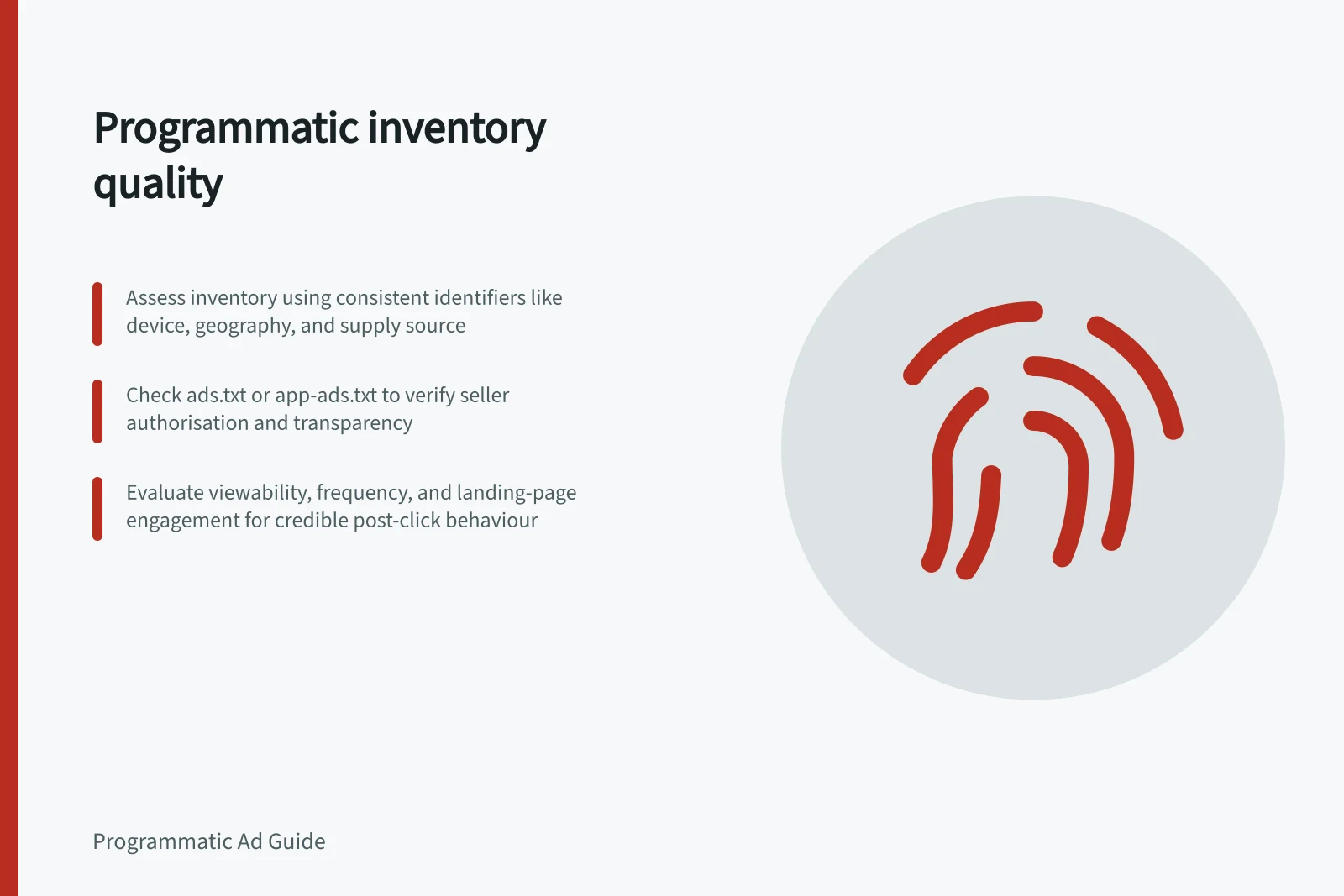
Assess inventory against a consistent view of placement identity, device, geography, supply source, spend and campaign outcomes. Clear identifiers matter because a display name may not distinguish an app from a website or one app bundle from another. Treat unknown and low-transparency inventory as visible categories rather than obscuring it within a broad group.
Use material spend and campaign outcomes to frame review priorities, and interpret engagement in context. Compare like with like: different environments and creative formats can behave differently, and market or device conditions may affect delivery.
Programmatic Ad Quality Insights from Australian Sources
- 3 in 4 agencies expect programmatic OOH investment to riseIAB Australia report
- CTV quality management includes frequency capping and ad repetition controlsIAB Australia guidelines
- Low-quality MFA websites impact advertising industry credibilityThe Drum analysis
Separate four quality questions
| Question | Evidence to inspect | Decision |
|---|---|---|
| Is the seller authorised? | Seller-status reporting, ads.txt or app-ads.txt signals where available | Investigate non-participating or unauthorised supply in context |
| Is the context suitable? | Domain or app identity, page category, placement details | Exclude a documented mismatch |
| Is the exposure useful? | Viewability, frequency, device and geography | Adjust targeting or creative before blaming the publisher |
| Does traffic act plausibly? | Landing-page engagement and meaningful conversion stages | Trace tracking and traffic before drawing a fraud conclusion |
Display & Video 360 documents authorised-seller states and reports invalid-traffic filtering among reasons impressions are filtered. Those controls are helpful, but they do not make every unflagged impression valuable. Nor does a cheap impression with no conversion prove fraud. Check landing-page failures, attribution settings and small samples first.
Treat seller signals as transparency evidence
The IAB Tech Lab’s ads.txt initiative lets publishers identify who is authorised to sell their web inventory; app-ads.txt extends the approach to mobile and connected TV. A participating publisher has an associated file, but participation is not mandatory. The presence or absence of a file is therefore a transparency signal, not a complete verdict on whether an impression is useful.
Display & Video 360 checks sellers identified in the SupplyChain object, including intermediaries, against publisher ads.txt and app-ads.txt files. It automatically excludes inventory from sellers it identifies as unauthorised. Non-participating publishers are a different case: their inventory can be bought at the buyer’s risk by changing inventory-source targeting in the buying policy.
Connected TV needs particular care when interpreting that distinction. Display & Video 360 treats CTV devices that do not support app-ads.txt as non-participating and will bid regardless of the advertiser’s targeting criteria. Assess that platform behaviour separately from a finding that a seller is unauthorised.
Change one control with a reason
A documented concern about one placement does not automatically justify excluding an entire domain, and broad exclusions may reduce access to otherwise suitable inventory or the intended audience.
Weigh potential quality gains against effects on reach, spend and outcomes. Targeting choices can also have wider implications: for example, Display & Video 360 may include a corresponding app when a website is targeted, depending on environment targeting.
Changes in supply, campaigns or tracking can alter the evidence; assess performance shifts alongside changes to inventory rules and measurement.
Use delivery diagnostics as context
A filtered impression or reduced delivery can have different causes, so it should not automatically be treated as an inventory-quality failure. Display & Video 360 diagnostics distinguish among reasons including invalid traffic, unauthorised sellers, domains that could not be crawled for brand-safety checks, and requests received before a deal was created.
Use diagnostics to distinguish inventory availability and auction outcomes from filtering or targeting issues. More detailed Troubleshooter data may take longer to become available, so allow for that before treating an apparent change as a stable signal.
Include exposure and context in the quality picture
For connected TV, quality also includes the viewing experience, not just the seller and the campaign result. IAB Australia describes frequency capping as a basic control for user experience and advertising effectiveness, and highlights competitive separation and avoiding repeated plays of the same ad within a break as CTV concerns.
IAB Australia also points to content signals, ad formats and ads.txt or app-ads.txt management as parts of CTV quality management. Treat these as complementary checks: a clear seller path does not establish that the content context or repetition is appropriate, while a suitable context alone does not verify who sold the impression.
In this guide
- Reviewing domain and app placement reportsA placement report is useful when every important row can be tied to a decision.
- Finding low-value placements behind cheap impressionsCheap impressions are low value when they consume budget without useful exposure or subsequent action.
- Investigating abrupt changes in traffic qualityWhen traffic quality changes suddenly, find the point at which the pattern broke before changing exclusions.