Inventory Quality
Part of Programmatic inventory quality
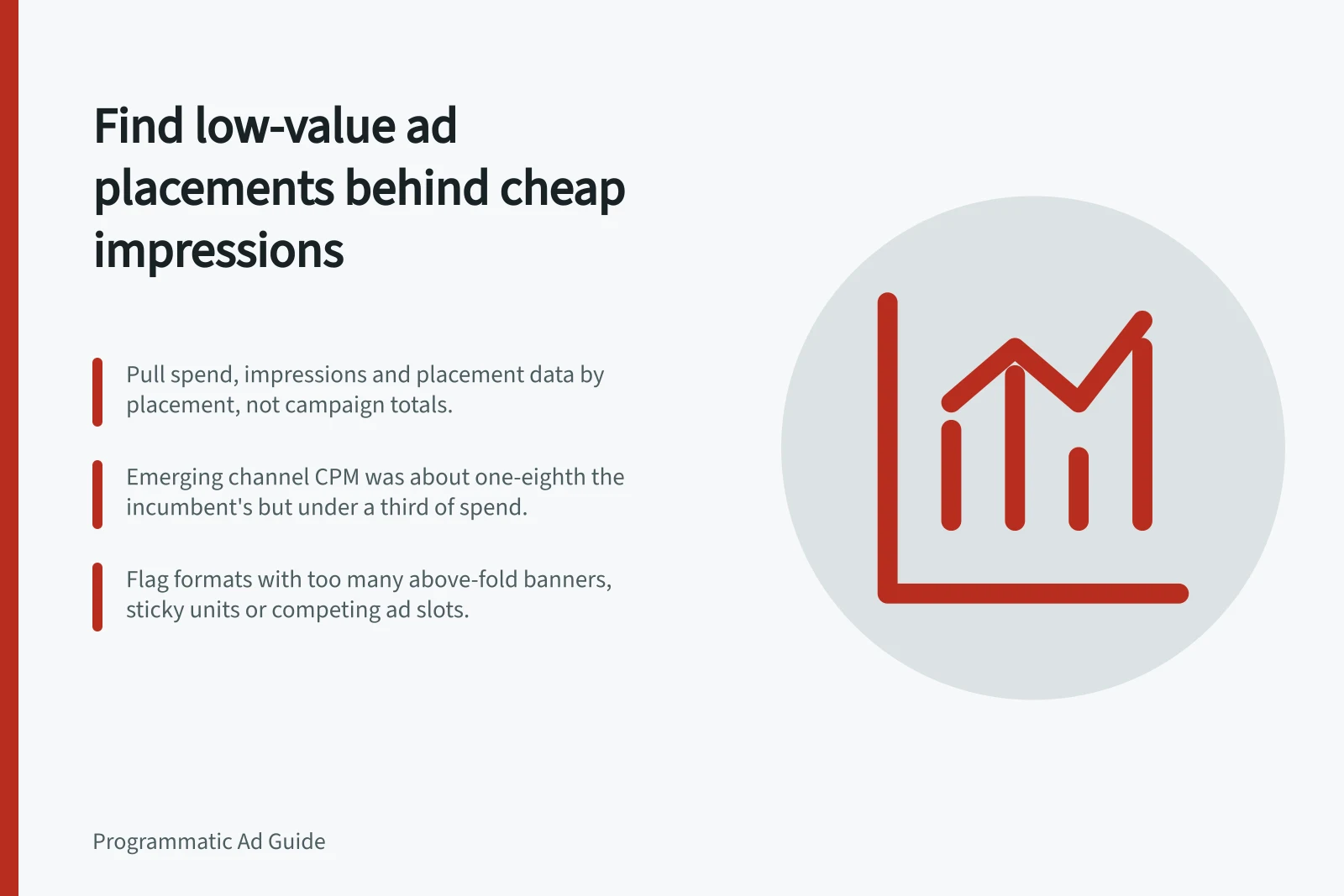
Finding low-value placements behind cheap impressions
Cheap impressions are low value when they consume budget without useful exposure or subsequent action.
Cheap impressions have low value when they spend budget without useful exposure or subsequent action. Price alone cannot identify them.
Treat cheap as a relative screen within the same campaign, not a fixed CPM band. A low price makes a placement worth checking, not automatically wasteful.
Flag formats for inspection when they rely on too many banners above the fold, sticky units that block content, multiple units competing for attention, or ad slots in areas users barely notice. These are placement-design warning signs, not proof of invalid traffic.
Placement-design warning signs to inspect
- Too many banners above the fold
- Sticky units that block content
- Multiple units competing for attention
- Ad slots in areas users barely notice
Calculate beyond CPM
Start with delivery data broken out by individual placement, not campaign totals. Pull spend, impressions and placement, plus region where available, and sort candidate rows by CPM within the same campaign.
Compare candidate placements with others serving the same campaign goal, using consistent attribution windows and device definitions. Channel-level data alone cannot establish which individual placement is weak.
Vizuro’s clinic case used a full year of weekly spend and impression data across two paid-social channels, then examined placements and regions separately. It shows how to extend a channel-level view to individual placements.
The emerging channel delivered impressions at roughly one-eighth the incumbent channel’s cost per thousand, yet received well under a third of total spend. This is a channel result, not a placement cutoff: judge a placement by its contribution to the campaign goal, not price alone.
For each material placement, compare spend with viewable impressions, meaningful site sessions and the conversion stage the campaign was designed to influence. Keep attribution windows and device definitions consistent.
For a practical session-quality proxy, look for visitors who spend time reading, scroll naturally or return regularly. Accidental pageviews and visits that end almost immediately are weak engagement signals, not evidence of a meaningful session.
Do not stop at viewability: a high viewability reading alone does not establish value. Check whether the placement also contributes engagement or the campaign-stage outcome, and use earlier signals such as qualified landing-page visits when a conversion sample is small; label these as proxies.
You can compare spend per viewable impression, meaningful site session or conversion at the intended stage. Compare like with like rather than applying an unsupported universal cutoff.
Clicks are not proof of quality. A click can be accidental, the landing page can fail to load, or the visitor can leave immediately.
Conversely, a branding placement may add value without a direct click. Compare the evidence with the campaign goal and its measurement limits.
Vizuro clinic case: emerging channel cost and spend share
- Emerging channel cost per thousand vs incumbentAbout one-eighth
- Share of total spend received by emerging channelWell under one-third
Placement-level value review workflow
- Pull spend, impressions and placement data for individual placements, not campaign totals
- Sort candidate rows by CPM within the same campaign
- Compare placements serving the same campaign goal using consistent attribution windows and device definitions
- Compare spend with viewable impressions, meaningful site sessions and the intended conversion stage
- Pause weak placements for a defined review period and compare displaced spend with where the campaign then serves
Check for a simpler explanation
Before you exclude a cheap placement, inspect the ad format, creative crop, market, frequency and landing-page experience. One app may produce poor form starts because the form is hard to use on a small screen.
A site may look weak because a tracking tag was missing for its landing route. These are testable operational issues, not grounds to accuse the publisher of invalid traffic.
Other warning patterns include weak user engagement, accidental pageviews and unstable sources. Check these against the placement’s exposure and outcome data; they are clues to investigate, not proof of misconduct.
A placement is a stronger candidate for review when cheap CPM comes with weaker useful exposure or campaign-stage outcomes than comparable placements. Write down the relative quality threshold you will use; do not substitute a fraud label or an unsupported CPM band.
If the placement remains weak after tracking and creative checks, pause it for a defined review period. Compare the displaced spend with where the campaign then serves.
A successful change raises the share of useful exposure or outcomes without sharply reducing reach among the intended audience. Record both effects so a cheap but useful placement is not removed by a simplistic rule.
Check for a simpler explanation before excluding a cheap placement
- Ad format and creative crop
- Market and frequency
- Landing-page experience, including small-screen form usability
- Missing tracking tag on a landing route
- Weak user engagement, accidental pageviews or unstable sources