Bidding & Pacing
Part of Programmatic campaign audits
Reviewing wasted spend before the next campaign
Classify possible wasted programmatic spend, check its cause and make a bounded decision for the next campaign.
Before you approve the next buy, review potentially wasted spend. Look for material paid delivery that breached an approved requirement, or that has weak evidence of value against the agreed objective. Then check competing explanations. Unspent budget is a delivery shortfall; an impression without a conversion is not automatically waste, especially when the goal was exposure.
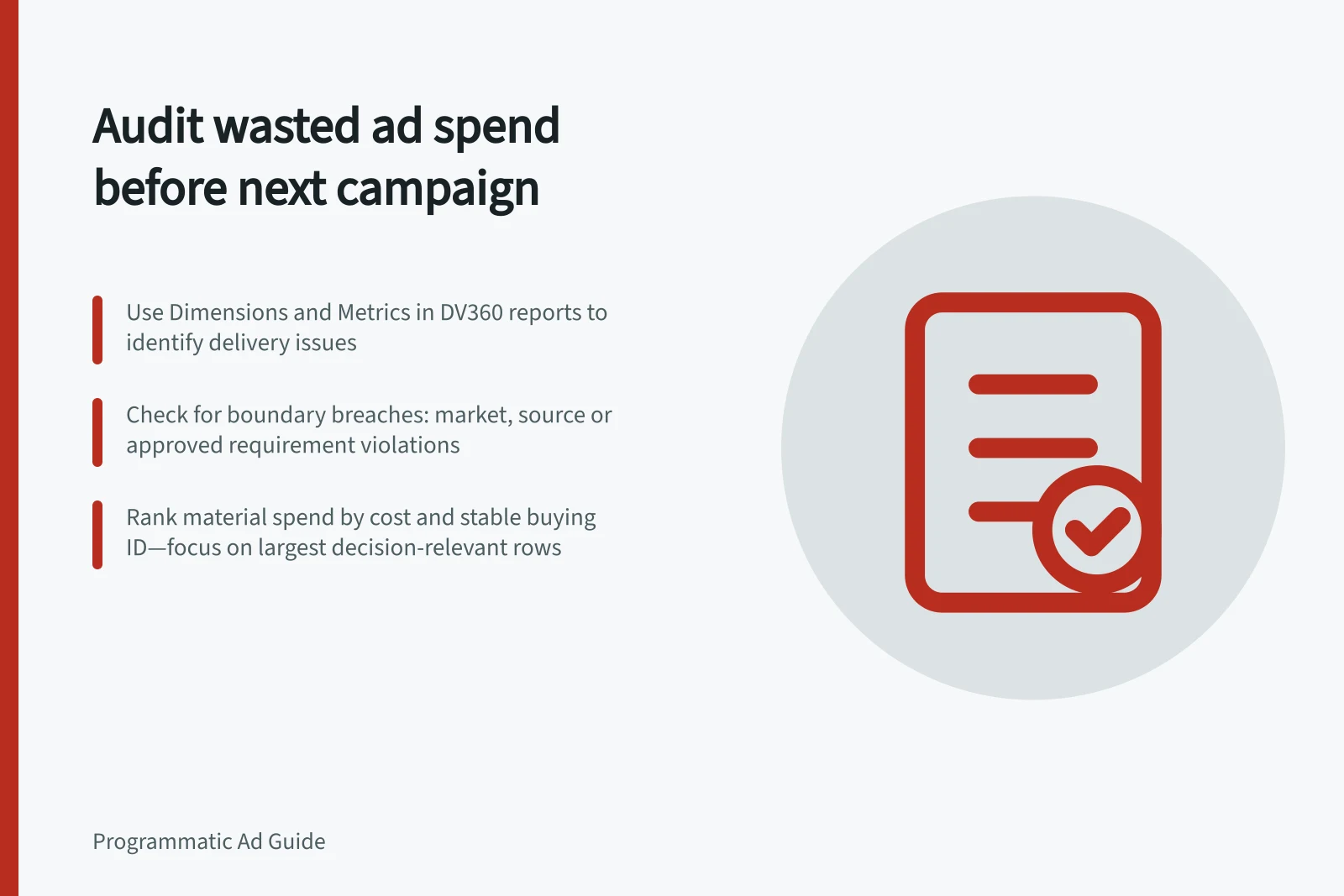
For a Display & Video 360 review, use Dimensions in reports and Metrics in reports to select available report breakdowns and measures. Use Troubleshoot your deals and line items to investigate delivery problems before treating a row as avoidable spend.
Classify the finding
Separate confirmed boundary breaches, spend that may be worth reallocating and spend whose value is unknown because evidence is missing. The first needs a compliance response; the second needs a defensible comparison; the third needs better reporting before anyone assigns a waste total.
Treat a row as material only if changing its allocation or control could change the next campaign decision. Rank candidates by reported cost so the largest decision-relevant rows are checked first; do not invent a numerical cutoff.
Use one cost basis and name it: state the selected metric, A$ currency, report dates and named time zone. Use the metric label shown in the report, and do not compare rows on different cost bases. The reported cost may not equal the advertiser’s full charge.
Classifying Programmatic Spend: Confirmed Breaches vs. Reallocatable vs. Unknown Value
- Confirmed Boundary BreachesRequire compliance response; e.g., spend outside approved market or source.
- Spend Worth ReallocatingNeeds defensible comparison; e.g., weak completed outcomes despite investment.
- Value Unknown (Missing Evidence)Requires better reporting before waste can be assigned; e.g., no tied outcome data.
Find the spend that could change a decision
Rank spend by stable buying ID and relevant supply grouping. Start with deals and line items, then split them only by dimensions available in the report. Where the report supports those combinations, add placement or app identity, format, device, market and the agreed outcome. Check the largest material pools first. Keep small rows separate; do not treat a missing outcome as proof of poor value.
| Finding | Check before deciding | Next-campaign option |
|---|---|---|
| Paid delivery outside an approved market or source | Saved rule, identifier and dates | Correct the control and approval process |
| Material spend with weak completed outcomes | Event health, destination and comparable buying conditions | Limit, repair or retest the buy |
| Heavy repeated exposure | Combined reach and frequency, where available | Reconsider the audience or allocation |
| Outcome cannot be tied to meaningful rows | Report fields, permissions and event definition | Improve the evidence pack |
If a row is grouped or its placement is unknown, do not assign it a precise site-level result.
Keep deal or line item findings at the level the report supports, and record the relevant report breakdown rather than implying a more precise result.
Steps to Review Wasted Spend Before the Next Campaign
- Rank spend by stable buying ID and supply groupingStart with deals and line items; then split by available report dimensions.
- Check largest material pools firstFocus on high-cost, decision-relevant rows; avoid arbitrary numerical cutoffs.
- Keep small rows separateDo not assume poor value just because an outcome is missing.
- Use consistent cost basisState metric, A$, report dates, and time zone; use only one cost measure.
Key Metrics to Track in Spend Review
- Reported Cost (A$)Use metric as shown in report; do not compare across different cost bases.
- Denominatore.g., impressions, reach, frequency – must be clearly defined.
- Outcome CountNumber of completed actions (e.g., conversions); must be measurable.
- UncertaintyMark fields unknown if not exposed in report; avoid assumptions.
Check the explanation before changing the next buy
A weak row may reflect its inventory, creative, landing page or measurement. Compare similar formats and markets, and check changes during the period. Higher spend followed by fewer completed actions does not identify which factor caused the change.
Use delivery diagnostics to interpret delivery outcomes. A filtered request is not paid spend. A low-value bought placement is not necessarily invalid traffic.
For a boundary breach, copy the approved requirement exactly into the decision note. Record it in this form: “[approved requirement] was breached by [deal or line item] during [report dates]; [exclude/limit/repair and retest/leave open] next campaign.”
For each candidate, record spend, period, denominator, outcome count, uncertainty and a bounded decision: exclude, limit, repair and retest, or leave open. Name the exact rule if proposing an exclusion. At the next review, check where displaced budget went and whether useful delivery held. Do not claim savings that were never measured.
Keep the record on one line: deal or line item, reported cost metric and A$ amount, report period and time zone, denominator, outcome count, uncertainty and decision. If the report does not expose a field, mark it unknown and leave the decision open rather than filling the gap with an assumption.
Evaluating a Weak Row: Possible Causes and Actions
- Pros (Valid Reasons for Low Outcome)Inventory quality, creative performance, landing page issues, or measurement limitations may affect results.
- Cons (Misinterpretations to Avoid)Higher spend followed by fewer conversions does not identify root cause; filtered requests are not paid spend.
Bounded Decision Framework for Next Campaign
- Record full details on one lineDeal/line item, cost metric (A$), period/time zone, denominator, outcome count, uncertainty, and bounded decision.
- Apply bounded decisionsExclude, limit, repair and retest, or leave open – name exact rule if excluding.
- Track displaced budgetAt next review, verify where reallocated funds went and whether useful delivery held.
- Do not claim unmeasured savingsOnly report actual, measured outcomes; avoid inflated claims.