Measurement
Part of Programmatic campaign measurement
Distinguishing served, measurable and viewable impressions
See how served, eligible, measurable and viewable impressions differ, which denominator each Active View rate uses, and what remains unknown.
Served, Active View eligible, measurable and viewable impressions differ at each step. The count and denominator matter when comparing rates.
Follow the measurement path
In Display & Video 360, a served impression may be ineligible for Active View. An eligible impression may still be unmeasurable. Only a measurable impression can be classified as viewable or not viewable. These counts should not be collapsed into a single percentage without naming its denominator.
| Count | What it answers | What it does not answer |
|---|---|---|
| Served impressions | How many the delivery report counted | Whether the ad was on screen |
| Active View eligible impressions | How many met the supported format and tag requirements | Whether measurement succeeded |
| Measurable impressions | How many yielded viewability data | Whether they met the viewability threshold |
| Viewable impressions | How many measurable impressions met the threshold | Whether anyone paid attention or acted |
Different rates use different denominators. A high viewable count relative to measurable impressions, alongside low measurability, leaves substantial uncertainty about unmeasured impressions. Request the underlying counts and keep the measurement vendor and traffic-filtering basis consistent.
Served, Eligible, Measurable and Viewable Impressions: Key Differences
- Served impressions
- How many the delivery report counted
- Active View eligible impressions
- How many met the supported format and tag requirements
- Measurable impressions
- How many yielded viewability data
- Viewable impressions
- How many measurable impressions met the threshold
Use the threshold for the reported format
Active View applies a visibility threshold to the reported format. Check the reported metric and the current Google documentation for the threshold that applies. A visibility threshold is an exposure threshold, not a measure of attention. A lower measurability figure does not, by itself, show that viewers scrolled past more ads.
Compare a report without mixing denominators
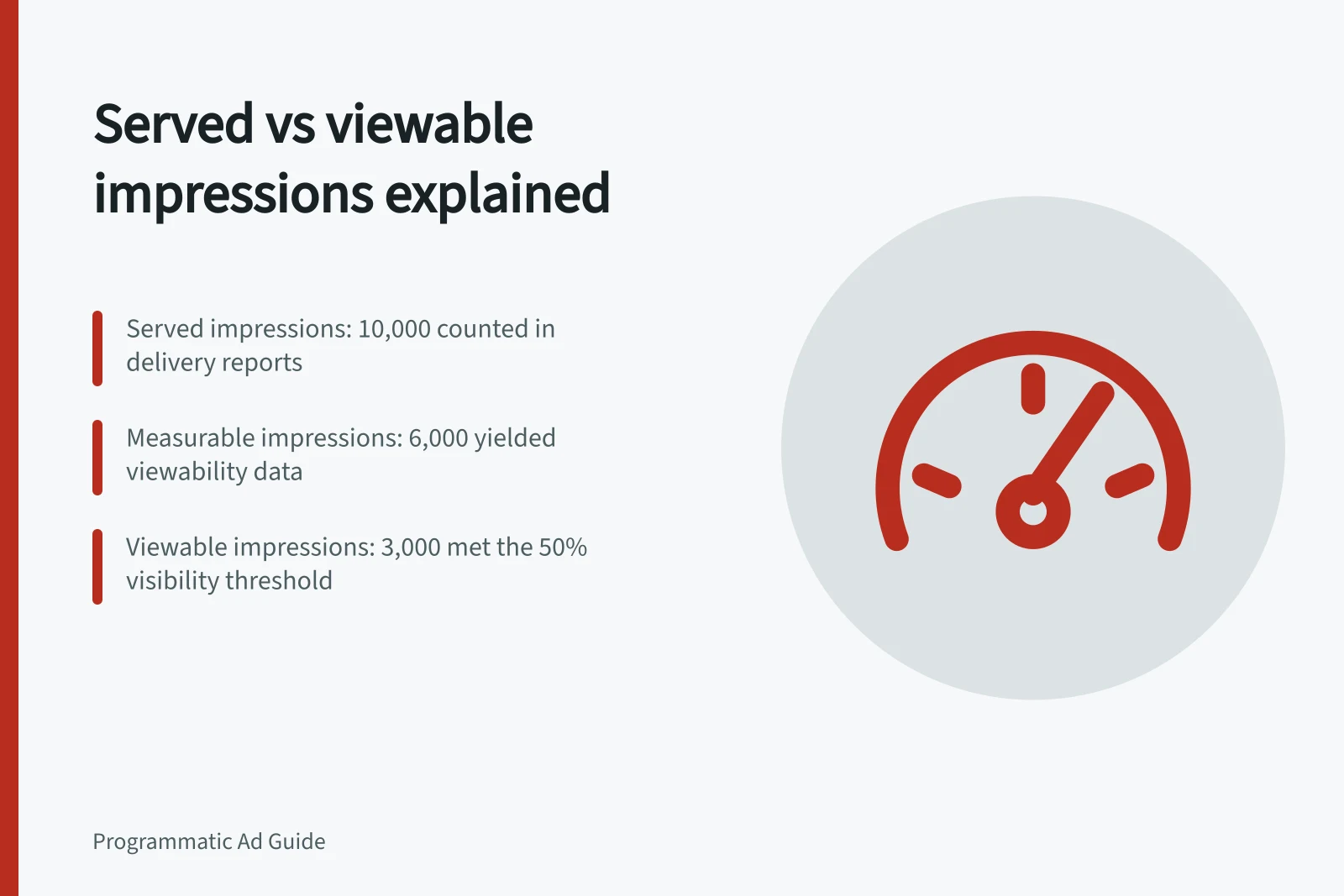
An illustrative report created for this article has 10,000 served impressions, 8,000 Active View eligible impressions, 6,000 measurable impressions and 3,000 viewable impressions.
In that illustration, measurable divided by eligible is 75%, viewable divided by measurable is 50%, and viewable divided by served is 30%. These are illustrative ratios, not quoted Active View definitions. Each ratio should be labelled with its denominator.
For a placement comparison, use the same period and comparable formats, measurement methods and invalid-traffic treatment. Show both coverage and viewability. If an impression was unmeasurable, its viewability is unknown; do not classify it as either viewable or not viewable.