Private Deals
Part of Running a programmatic advertising campaign
Open auction versus private marketplace buying
Compare open auctions, private auctions and preferred deals by access, price rule, delivery commitment and campaign fit.
Compare open-auction buying with private marketplace buying across inventory, price rule, delivery commitment and management effort. A private deal can set access terms, but it does not automatically improve results or guarantee impressions.
Identify the transaction
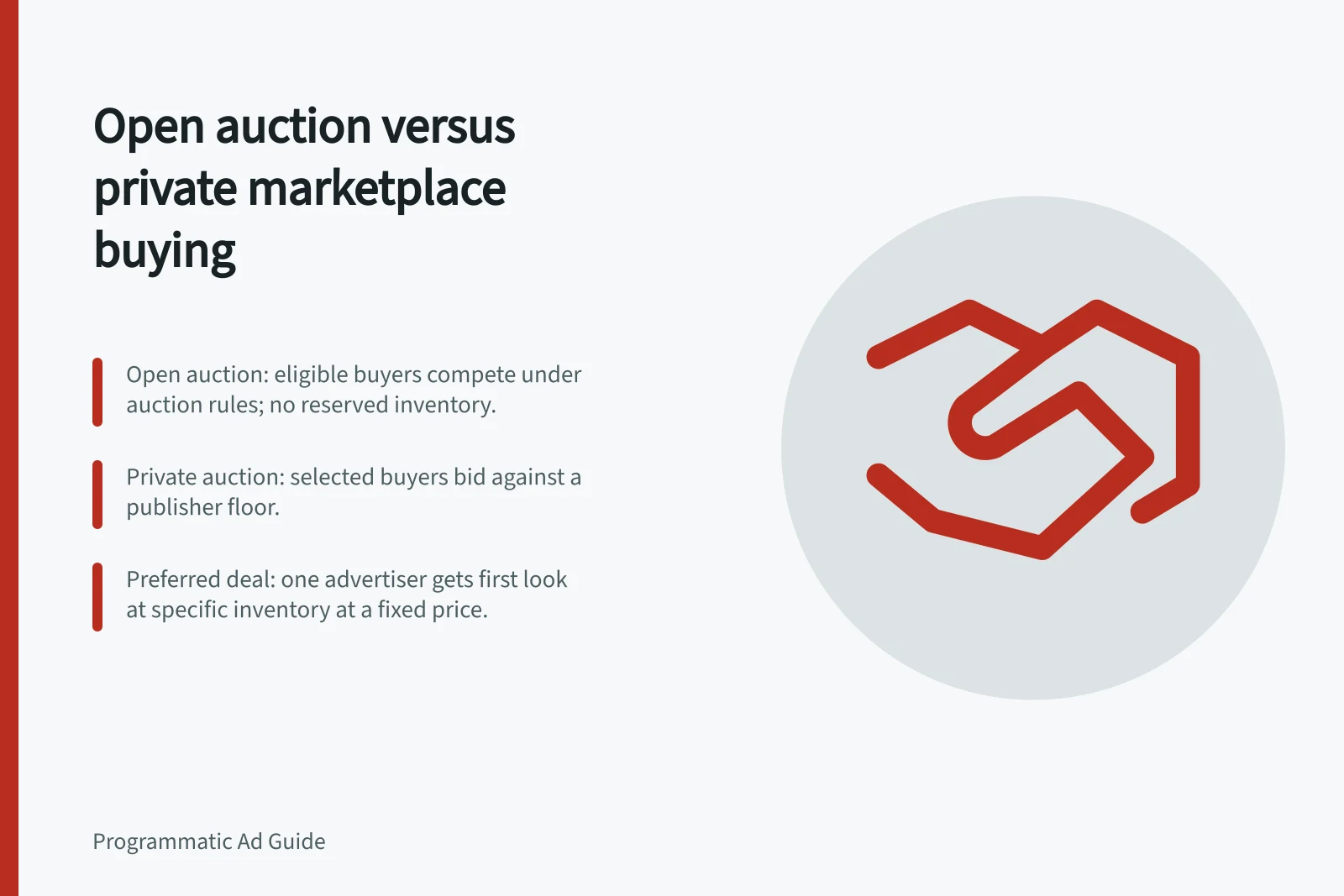
Google names the Open Auction, Private Auctions and Preferred Deals, and also describes Programmatic Guaranteed and Private Marketplace deals. In an open auction, buying systems assess an available ad opportunity, submit bids and serve the winning ad under the auction rules.
A private auction invites selected buyers to bid on selected publisher inventory, subject to a floor price. A preferred deal gives one advertiser first look at specific inventory at an agreed fixed price. Programmatic Guaranteed involves the buyer and publisher agreeing inventory and terms in advance.
| Route | Access and price | Delivery commitment |
|---|---|---|
| Open auction | Eligible buyers compete under auction rules; price follows the auction conditions | No reservation for this campaign |
| Private auction | Selected buyers bid against a publisher floor | Generally no reserved inventory; delivery depends on winning bids |
| Preferred deal | One advertiser gets first look at specific inventory at an agreed fixed price | First-look opportunity, not reserved volume |
| Programmatic Guaranteed | Buyer and publisher agree inventory and terms | Check the contracted quantity and dates |
A private-auction floor is a minimum bid condition, not the final price for every impression. Compare the actual offer’s site or app, placements, formats, market, dates and reporting detail; its label alone does not establish what can be bought.
Open auction, private auction, preferred deal and Programmatic Guaranteed compared
- Open auctionAccess: eligible buyers compete under auction rules. Price: follows the auction conditions. Delivery commitment: no reservation for this campaign.
- Private auctionAccess: selected buyers bid on selected publisher inventory. Price: bids against a publisher floor. Delivery commitment: generally no reserved inventory; delivery depends on winning bids.
- Preferred dealAccess: one advertiser gets first look at specific inventory. Price: agreed fixed price. Delivery commitment: first-look opportunity, not reserved volume.
- Programmatic GuaranteedAccess and price: buyer and publisher agree inventory and terms in advance. Delivery commitment: check the contracted quantity and dates.
Compare usable inventory and total cost
An open auction may suit a plan needing flexibility across eligible supply and reach across publishers. A private offer may suit a requirement for named publisher inventory or particular placements. In either route, targeting, creative eligibility and suitability rules can reduce the impressions available to the campaign.
Advertisers typically buy through a demand-side platform (DSP); publishers use supply-side platforms (SSPs) and ad management systems, while an ad exchange connects buyers and sellers. One company may provide several of these functions, so a campaign will not necessarily involve separate businesses for each role.
Compare cost against the same outcome and cost definition. A private-auction floor is a minimum bid condition, while a preferred deal states a fixed price; neither term on its own establishes the total cost or volume delivered.
Include applicable data, platform and service costs when comparing budgets. CPM alone cannot establish which route produces the better result.
Check delivery limits before shifting budget
Open-auction buying uses targeting and budget rules across eligible opportunities. A private deal adds deal-specific checks: confirm the deal ID, dates, price rule, eligible formats and creatives, publisher restrictions and expected request volume. A line item may not win every opportunity; Google Display & Video 360 provides troubleshooting for deals and line items.
Before moving spend, compare expected request volume and reported eligible opportunities with bought impressions, spend and the chosen outcome. For Programmatic Guaranteed, also check delivery against the contracted quantity and dates. These checks show whether the available opportunities and delivery match the terms, without treating a floor price or first-look opportunity as a volume commitment.
If both routes are viable, a limited comparison can help assess them. Hold the objective, dates, geography, formats and outcome definition as consistent as practical, and record differences in inventory and audience. Such a comparison may guide allocation, but differing placements and audiences mean it does not isolate the transaction type as the cause of any result.
Open auction still requires attention to targeting, creative eligibility and suitability. A private route also requires checking its access terms and, where applicable, deal ID and contracted delivery, so allow for that additional deal-specific management.
Choose the open auction when its eligible supply fits the brief and flexibility matters. Choose a private offer when its specified inventory or terms meet a documented requirement. For reserved volume, seek a guaranteed proposal and verify the contract.
Delivery and deal checks before shifting budget
- Confirm the deal ID, dates, price rule, eligible formats and creatives, publisher restrictions and expected request volume.
- Use Display & Video 360 troubleshooting for deals and line items where available.
- Compare expected request volume and reported eligible opportunities with bought impressions, spend and the chosen outcome.
- For Programmatic Guaranteed, check delivery against the contracted quantity and dates.
- If comparing routes, hold the objective, dates, geography, formats and outcome definition as consistent as practical, and record differences in inventory and audience.
- Allow for additional deal-specific management when using a private route.