Measurement
Part of Programmatic conversion tracking
Reconciling DSP conversions with first-party records
Align events, periods, attribution rules and report metrics before explaining gaps between DSP and first-party results.
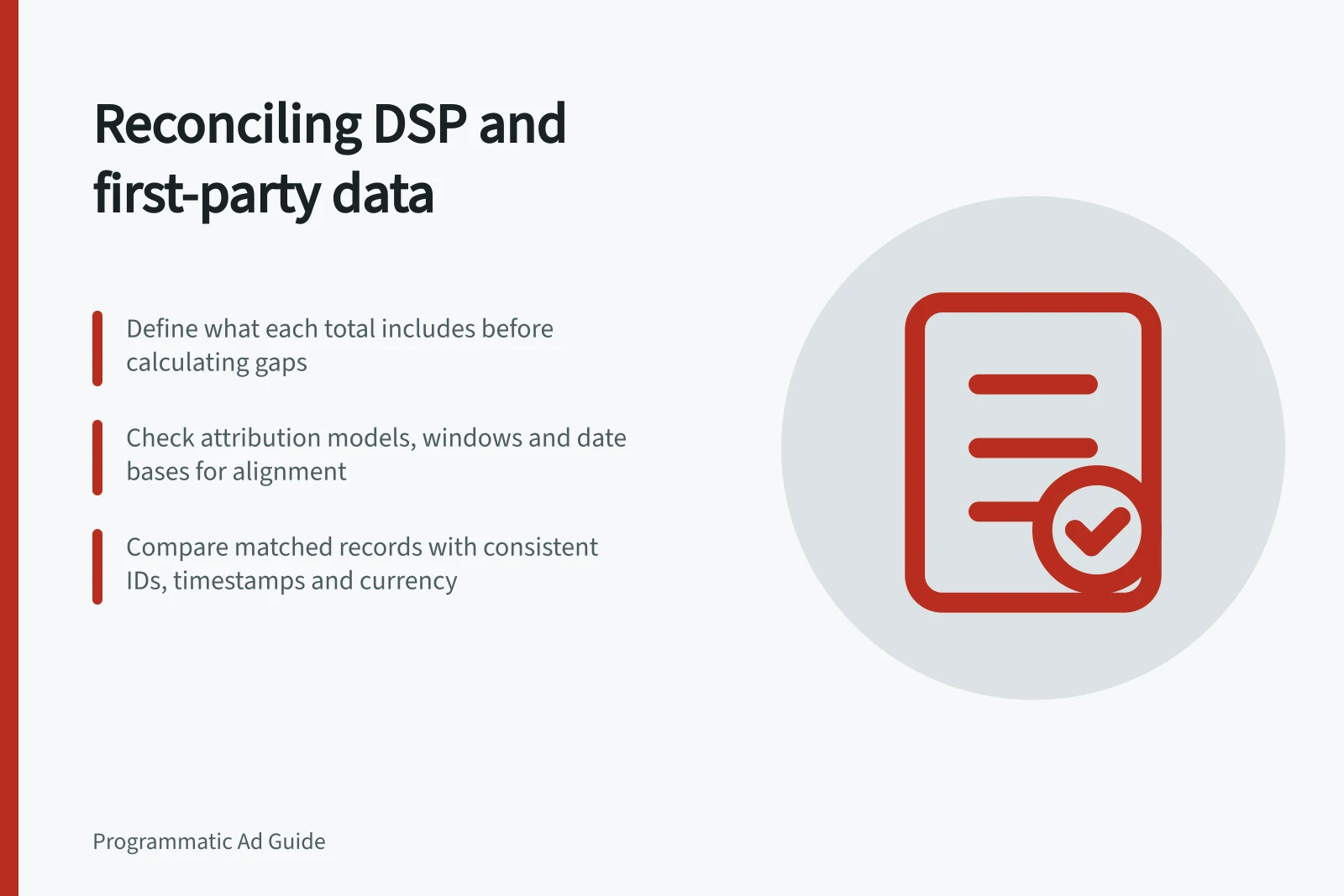
Define what each total includes before calculating a gap between DSP conversions and first-party records. The order or lead system records business actions. A DSP reports actions attributed under selected events, interactions, windows and models. Totals can differ even when both systems work as configured.
Build comparable extracts
Choose one completed outcome and a period. Export first-party records with stable IDs, action timestamps, status, currency and value where relevant. Keep cancellations, refunds and test actions identifiable until the comparison rule is agreed.
For the DSP extract, record the advertiser, included line items, activity, metric, attribution model, post-click and post-view windows, date basis and reporting time zone. Confirm which Floodlight activities and conversion-counting settings are represented in the DSP metric. A broad total may therefore include more than the completed action being reconciled.
| Gap to examine | First check |
|---|---|
| More first-party orders than DSP conversions | Are the orders inside the DSP’s event and attribution scope? |
| More DSP events than completed orders | Does the trigger fire early or repeatedly, or does the metric include another activity? |
| Similar totals but different daily patterns | Do the timestamps, date basis and time zones align? |
| Values differ while counts are close | Are currency, tax, shipping, refunds and sent values defined consistently? |
The size or direction of a gap alone does not identify its cause.
Key Data Elements for Accurate DSP and First-Party Comparison
- Required first-party fields
- Stable ID, action timestamp, status, currency, value, cancellation/refund flag
- Required DSP report details
- Advertiser, line items, attribution model, post-click/post-view windows, date basis, time zone
- Critical consistency checks
- Currency, tax, shipping, refunds, sent values, time zone alignment
- Report freshness consideration
- Note extraction time; re-run after cohort maturity
Move from totals to records where possible
If the permitted data and report provide suitable IDs, group records as matched, first-party only, DSP only, or matched with differing values or dates. Examine samples against the event trigger and order-status history. Customer identity alone is insufficient for an order-level join.
An attributed DSP conversion requires an eligible ad interaction under the chosen rules; a first-party order does not. Window and model settings can change the credited population.
Check how the selected attribution model defines eligible interactions and credited outcomes. Check the exact metric and report before expecting a one-to-one transaction-ID match.
Report freshness can vary. Record when each extract was taken and rerun a comparable report after the relevant cohort has matured. Platform reporting timing does not establish a settlement time for a particular campaign.
Explain the remaining gap
Write a bridge from the first-party total to the DSP total: records outside the business definition, actions outside attribution scope, missing or repeated events, and the difference that remains unexplained. If privacy or report granularity prevents a record-level join, state that limit and reconcile only the aggregates that can genuinely be compared.
Correct a broken event or mapping. Document legitimate scope differences and keep unexplained variance open. Use the business system for completed-order volume and the DSP report for the defined attribution measure.